Theory
Introductory MR Concepts:
The following section will present a constructive derivation of the Bloch and Bloch-Torrey equations and their corresponding analytical solutions. The material discussed in this section is fundametal to understanding diffusion-weighted MRI signal aquisition and modeling, and naturally motivates the need for Monte-carlo methods to simulate diffusion MRI.
The Physics of Magnetic Resonance
In this section, we will present the physical concept of Zeeman splitting and its relationship to Nuclear Magnetic Resonance (NMR) [1]. Given the quantum-mechanical nature of this physical phenomenon, throughout this section we will frequenlty use Paul Dirac’s bra-ket notation. Therefore, to be precise:
Letting \(\mathcal{H}\) be a finite dimensional vector space, \(v \in \mathcal{H}\) may be denoted by the symbol \(\ket{v}\), called a ket. Its corresponding element in the dual space \(\mathcal{H}^{*}\), denoted by \(\langle v, \cdot \rangle = \bra{v}\) is called a bra and can be thought of as a functional that acts on \(\ket{v}\). Appling a bra to a ket forms \(\langle u | v \rangle = \langle u, v \rangle\), a bra-ket, which is an inner product on \(\mathcal{H}\).
We will begin by discussing Angular momentum. The conservation of angular momentum is a fundamental physical law that reflects the isotropy of space. We will denote the total angular momentum operator by \(\mathbf{J} = \begin{pmatrix}J_{x}, & J_{y}, & J_{z}, \end{pmatrix}\) Assuming, by convention \(z\) to be the quantization axis, we have the following relationships:
Where \(j\) assumes interger or half interger values, and \(m\) assumes values \(-j, -j+1, \cdots j\)
Protons, the particle of interest in most MRI and diffusion MRI experiements, however, are equipped with a sort of internal angular momentum called spin. In particular, the spin of a \({}^{1}H\) nucleus is an intrinsic angular momentum that describes the internel degrees of freedom of the proton. We will denote the spin angular momentum operator by
Because \(\mathbf{I}\) is an angular momentum operator, it satifies the eigenvalue relations for the general angular momentum operators presented above. In particular, we have that
where \(I = \frac{1}{2}\) and is thus quantized by \(m = -\frac{1}{2}, +\frac{1}{2}\), and \(\sigma_{i}\) the i-th Pauli matrix.
Given a spin operator, we may define that spins nuclear magnetic moment operator, \(\boldsymbol{\mu}\). The relationship between the nuclear magnetic moment operator \(\boldsymbol{\mu}\) and the angular momentum operator is given by
where \(\gamma_{N}\) is the gyromagnetic ration and \(h\) is Plank’s constant.
Therefore, a proton (with no kinetic energy) moving in a homogenous electromagnetic field is described by the following Hamiltonian operator, which can be thought of as the generator of the evolution our quantum system. In particular
Conventionally, the gradient is defined as \(\mathbf{B} = \begin{pmatrix} 0, & 0, & B_{0} \end{pmatrix}\).
Using the gradient defined above and substituting the Hamiltonian into the Schrodinger equation, we get that
Therefore, we see that the energy states of the quantum system are given by the expression
This equation has two important implications. First, we immediately notice that in the absense of an external gradient, the two possible energy states associated to quantum numbers \(\pm \frac{1}{2}\) are degenerate. Second, we see that in the presence of the external gradient, the degeneracy is resolved by the external gradient in a linear manner.
We remark that a non-trival population of spins with quantum number \(-\frac{1}{2}\) align in an anti-parallel manner with respect to the external gradient; however, this alignment corresponds to a higher Zeeman energy, and thus we observe spin excess in the parallel, \(+ \frac{1}{2}\), configuration. This phenomenon is called Zeeman splitting.
Fundamentally, NMR relies on transitions between the two Zeeman energies to initiate signal aquisition. The energy required to excite spins to the higher energy state is given by
The quantity \(\omega_{0}\) is called the Larmor Frequency, and generally falls into to the radio frequency (RF) range. Application of an RF pulse in the transverse plane, orthogonal to the net magnetization vector, at the Larmor frequency causes the net magnetization vector to tip out of its equilibrium state and precess about a new axis defined by the flip angle \(\alpha =\omega_{0}t\) where t is a time parameter. Receiver coils in the transverse plane measure the frequency of this precession, and thus a signal is detected.
The Bloch Equation
The Bloch equations model the time evolution of the net-magnetization vector:
The net magnetization, in some small volume element \(\Omega\) is
The Bloch equations, follow immediately from the above
However, the above expression is certainly oversimplified, as it neglects proton interactions with its local magnetic environment, which are modeled by the decay parameters \(T_{1}\) and \(T_{2}\). The derivation of the Bloch equations with relaxation terms is beyond the scope of this introduction, and we refer the interested reader to Bloch’s Nuclear Induction, 1970. In general, however, we remark it is this complete form of the Bloch equation that we are interested in solving.
For general experimental conditions, analytic solutions to the Bloch equations do not exist, and standard numerical recipies such as forward Euler time stepping are deployed. However, under certain simplifications an analytic solution is easily found. In particular, let \(\mathbf{B}\) be the a magnetic field normal to the transverse imaging plane.
Re-writing into a more convienent matrix form, we immediately see that differential operator acts as an affine transformation of the net magnetization vector.
Because \(\mathbf{A}\) is guaranteed to be invertible, we may define a mapping that produces a linear first order system of Differential Equations.
Under this mapping, we may re-write the Bloch-Equations more compactly as
which has the general time-dependent solution given by
The equilibrium value of \(\hat{\mathbf{M}}(\mathbf{r}, 0)\) represents the initial spin density, which seeks to minimize both the Zeeman potential and energy associated by the spins thermal contact with the ambient spin bath. We remark that more explicit closed forms may be obtained by recalling from statistical physics the Boltzman Distribution to elucidate the exact form of \(\hat{\mathbf{M}}(\mathbf{r}, 0)\) for a given temperature.
The Bloch equation represents a useful tool for analyzing the time evolution of a spin ensemble’s net magnization vector, \(\hat{\mathbf{M}}(\mathbf{r},t)_{\text{Bloch}}\), as the ensemble interacts with an external gradient \(\textbf{B}\) and applied RF pulses. However, the Bloch equation assumes that the spins themselves are stationary, which is not always the case. In 1956, H.C. Torrey, one of Purcell’s collaborators, generalized the Bloch equation to further model the motional processes of spins within the ensemble by adding a diffusion term to the Bloch Equation. The model proposed by Torrey, the Bloch-Torrey equation, is an important theoretical repository of modern MR techniques sensitive to motional processes. One notable example is of these techniques is diffusion MRI.
The Bloch-Torrey Equation
Diffusion of the spin ensemble’s net magnetization vector will generally take place by self-diffusion processes of NMR active (spin \(\frac{1}{2}\)) nuclei. By adding a diffusion term to the Bloch Equation, we obtain the phenomenological Bloch-Torrey equation. Like the Bloch equation, analytic solutions do not exist in general. However, under a certain set of assumptions, it is possible to construct an analytic solution. We will adopt a perturbation theoretic approach to show exactly these circumstances. Consider the following:
Re-writing the above equation into its matrix formulation, we obtain
Letting \((\varepsilon \longrightarrow 0)\), we see that the above equation may be written as
\(\mathbf{D}_{0}\) having no spatial dependence makes Bloch-Torrey amenable to an analytic solution. Of course, we make the remark that in biological solids, ordered tissue micro structure usually acts as a barrier to self-diffusion processes, and so the 0-th order approximation of the spatially-dependent diffusion tensor \(\mathbf{D}(\mathbf{r})\) is of course an incredible oversimplification. Still, finding the solution here will show important concepts regarding the Fourier relationship between the dMRI signal and the average diffusion propagator. Given that we are trying to motivate the need for Monte Carlo (MC) simulation, this is sufficient for our purposes.
We proceed by taking the Fourier transform
Collecting the Matrix valued terms, we obtain a linear system of Partial Differential Equations
The solution, as we have seen is the case for the Bloch Equation, is given by
Taking the inverse Fourier transform of this general solution, we obtain
Therefore, through application of Fubini’s theorem we can rearange the above into the following form
Finding a closed form for \(\mathbf{K}(\mathbf{r}^{\prime} - \mathbf{r}, t)\) amounts to computing the integral
Completing the square and simplifying to a more familiar form, we get that
However, making a simple change of variables \(\mathbf{q} \mapsto \frac{\mathbf{s}}{\sqrt{\mathbf{D}_{0}t}} + \frac{i}{2\mathbf{D}_{0}t} (\mathbf{r}^{\prime}-\mathbf{r} )\), we get a familiar form
Now the integral term here is just the Gaussian integral. We recognize this function as the self-correlation function which denotes the probability of moving from position \(\mathbf{r}\) to \(\mathbf{r}^{\prime}\) in time t. Henceforth, we will denote \(\mathbf{K}(\mathbf{r}^{\prime} - \mathbf{r}, t)\) by \(\boldsymbol{\mathcal{G}}(\mathbf{r} |\mathbf{r}^{\prime}, t)\)
Thus, the general solution to Bloch-Torrey is given by the following
Therefore, for certain initial spin ensemble distributions we can expect to have an analytic solution.
The Pulsed Gradient Spin Echo (PGSE) Experiment
Developed by E.O. Stejskal and J.E. Tanner in 1965, the pulsed gradient spin echo (PGSE) experiment sensitizes a spin ensemble’s echo signal to the molecular self-diffusion occurring between two applied gradient pulses [2]. The general idea is that a \((\frac{\pi}{2})_{x}`\) pulse tips the net magnetization into the transverse plane, and then the bulk magnetization is hit with a gradient, \(\mathbf{g}\), for duration \(\delta\) that encodes a position-dependent phase shift according to:
The spin ensemble is then refocused with a \(\pi_{x}\) pulse, and at time \(\Delta\) the gradient, \(\mathbf{g}\), is again applied for duration \(\delta\). Schematically, the PGSE experiement is represented by:
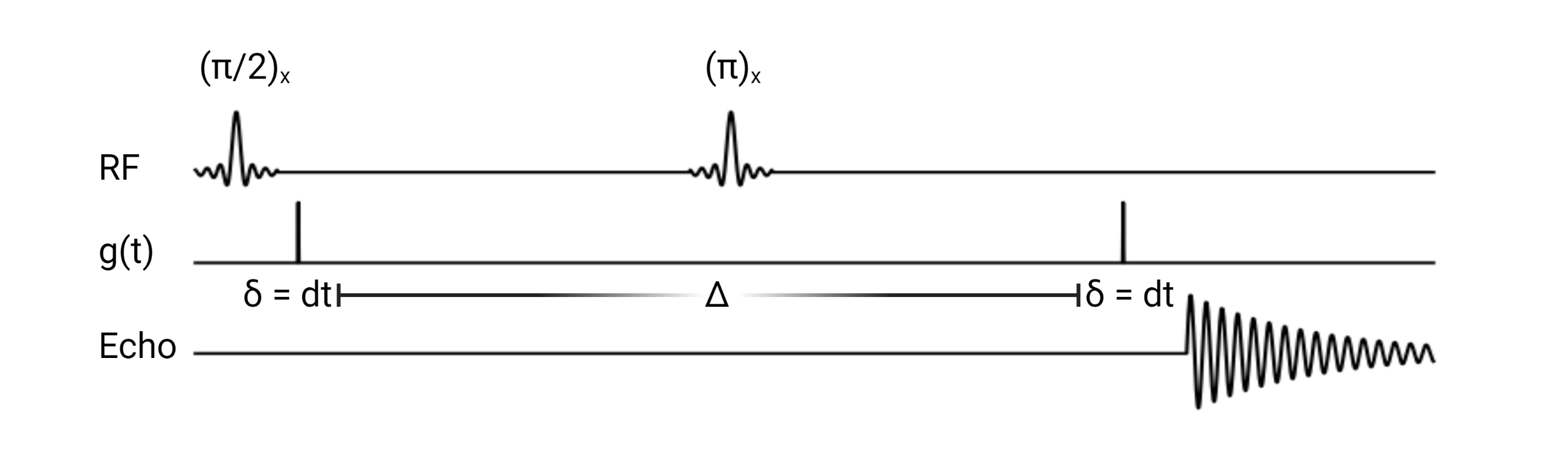
(Top) Pulse sequence generated by radio frequency, or RF, transmission coils. (Middle) Resultant diffusion gradient. (Bottom) Spin echo signal measured by RF receive coils.
As depicted by the schematic, we adopt the narrow pulse approximation of the applied magnetic gradients \(\mathbf{g}\). In particular, for the PGSE experiement we have that
where \(\mathbf{g} \in \mathbb{S}^{2}\) is the direction of the gradient and \(\delta\) is the duration of the gradient pulse.
Substituting this expression into the phase shift equation, we get that the phase shift at acquisition time \(TE = \Delta\) for the PGSE experiment is given by
Thus, we see that the phase shift is sensitive to the molecular self diffusion of a spin from position \(\mathbf{r}\) to position \(\mathbf{r}^{\prime}\). We remark that in the actual PGSE experiment, the gradient pulse is instead defined by a scaled Dirac delta so that the Fourier relationship between the signal echo and the diffusion propagator is more explicit.
The Stejskal-Tanner Equation
By the general solution we found for the Bloch-Torrey equations, the bulk magnetization vector, \(\hat{\mathbf{M}}(\mathbf{r}, t)\), is the product of two independent sources of decay. First, there is decay in the net magnetization due to the \(T_{1}\) and \(T_{2}\) relaxation terms within the expression \(\exp (\mathbf{A}t)\). Secondly, the magnetization vector experiences decay via the diffusion processes encoded in the Green’s function corresponding to the diffusion term. Because our goal is to measure the signal decay only from diffusion processes, we simply divide the measured signal echo in the presence of a gradient, \(S(\mathbf{g}, t)\) by the signal echo induced in the absence of an applied gradient, \(S(0, t)\), producing an echo attenuation sensitive only to the self-diffusion processes of magnetic moment bearing nuclei
Consider the PGSE experiment with wavevector \(\mathbf{q}\) and gradient \(\mathbf{g}\)
We make the remark that the frequency expression above is obtained by using the Larmor frequency \(\gamma B_{0}\) as a reference frequency so it may be neglected in the detection process. Therefore, for spins within some neighborhood of \(\mathbf{r}\) such that they may be described by the local magnetization density \(\boldsymbol{\rho}(\mathbf{r})\), the PGSE signal is given by
Substituting in the result fron phase shift expression
where \(\boldsymbol\rho(\mathbf{r})\) is given by the solution to Bloch-Torrey modulo the relaxation terms, which are safely accounted for via the division of the PGSE signal \(S(\mathbf{g}, t)\) by the Hahn echo signal \(S(0, t)\). Therefore
Making the substitution \(\mathbf{r} = \mathbf{r}^{'} - \mathbf{R}\) we get that
Here \(\bar{\boldsymbol{\mathcal{G}}}(\mathbf{R}, t)\) is usually referred to by the literature as the average diffusion propagator.
We make the remark that if the diffusion process is unbounded, then the kernel function \(\boldsymbol{\mathcal{G}}(\mathbf{r} | \mathbf{r}^{\prime}, t)\) has no functional dependence on \(\mathbf{r}\), but rather on the quantity \(||\mathbf{r}^{\prime} - \mathbf{r} ||^{2}\). Under these circumstances, we see that the average diffusion propogator is given by
Substituting the general form for the spin density \(\boldsymbol \rho (\mathbf{r})\) into signal attention expression, we get that
Defining a reciprocal space
The careful reader will realize that by the relationship: \(2\pi i \mathbf{q}^{\intercal} = i\gamma \delta \mathbf{g}^{\intercal}\), the PGSE experiment essentially is sampling the Fourier space of the diffusion propogator. In particular, we have that \(E(\mathbf{g}, t)\) is precisely the Fourier transformation of average diffusion propagator \(\bar{\boldsymbol{\mathcal{G}}} (\mathbf{R}, t)\)
In the case of free, unrestricted diffusion, the average propagator is known to us so we may actually compute the Fourier transform. By doing so we obtain the famous Stejskal-Tanner equation for the PGSE experiment:
The scalar \(\gamma^{2}\delta^{2}\mathbf{g}^{2}\Delta\) is usually called the b-value, or diffusion-weighting factor.
In more general cases, where diffusion is not completely unrestricted, \(\bar{\boldsymbol{\mathcal{G}}} (\mathbf{R}, t)\) and \(\mathbf{D}\) have spatial dependence, an analytic solution is intractable. Standard numerical methods like forward Euler time-stepping or Chebyshev Spectral Methods, may yield solutions when the spatial dependence of the diffusion tensor is not too complicated. On domains designed to mimic biological tissue, finding a parametization of the spatially dependent diffusion tensor is not possible. Therefore we must deploy Monte Carlo Simulation methods to sample the diffusion propogator and compute a solution.
Simulated Diffusion
To sample the diffusion propogator in a realistic manner, we simulate the molecular self-diffusion process for resident spins and calculate the resulting dMRI signal via pulsed gradient spin echo (PGSE) aquisition. The spin diffusion process is modelled via a random walk for each spin in the simulated ensemble. Spins are initially populated uniformly throughout the simulated image voxel. Subsequently, spin positions are updated at each time step under the constraint that they remain in the local environment in which they are initialized. Since the echo times typically used in diffusion magnetic resonance imaging (dMRI) experiments are below the mean preexchange lifetime (\({\tau_i}\)) of cellular water, we can safely neglect flux between the simulated microstructural components. The non-exchange of spins between tissue structures is ensured by rejection sampling of proposed steps beyond the relevant structure. At each time step \(\dd{t}\), spins are displaced by a distance determined by specified diffusivity of the relevant compartment. Spin displacment directions, \(\va{u} \in S^{2}\), are determined using the xoroshiro128+ pseudo-random number generator. Specifically, the displacement of a spin during the \({i^{\mathrm{th}}}\) time step is given by
Given the large number of spins required for convergence of the simulated PGSE signal, our code was developed with considerable attention towards preformance. To this end, spin trajectories are individually computed on a signle thread of the graphical processing unit (GPU), thus allowing for a non-linear relationship between the number of spins populated in the simulated voxel and overall runtime of the simulation. Typical experiements feature \({[0.25,\, 1] \times 10^6}\) spins and are completed within \(\sim 15\) and \(60\) minutes, depending on the complexity of the simulated microstructure.
The diffusion process may be simulated for arbitrary geometries characterized by:
\(N_{\mathrm{fibers}} \in [0,\, 4]\) distinct fiber populations, each with user-specified orientations, volume fractions, and intra-axonal diffusivities \(\mathbf{D}_{0}\), and
\(N_{\mathrm{cells}} \in [0,\, 2]\) distinct cell populations, each with user-specified radii and volume fractions.
Simulated Signal Acquisition
Data from the simulated spin trajectories is then used to compute the echo signal produced via PGSE sequence shown above:
The dMRI signal generated by the \(k^{\mathrm{th}}\) diffusion gradient \(\va{g}_{k}\) is calculated via standard numerical integration, which yields the following:
This signal can subsequently be used for, inter alia, the rapid prototyping, validation, and comparison of models for diffusion in biological tissue. At present, the authors are particularly interesting in evalutating various models of diffusion for their capacity to solve the inverse problem: recovery of ground truth intrinsic diffusivities for simulated biophysical structures in realistically-represented tissues.